MG Electricidad was founded in 1979 as an industrial automation company, providing electrical services to national and international companies. However, since the beginning of the century, we have diversified our automation services, seeking specialization in each discipline, such as the manufacture of industrial electrical panels and home automation.
We firmly believe in our work. Industrial automation is not only useful, but necessary for sustainability, the growth of any company, and industrial production. Automation regulates and improves manufacturing processes, efficiency, and therefore the economy of any industry. Below, we summarize our own definition of automation: what it is and what its values are for industry.
What is industrial automation?
At MG Electricidad, we research and pursue automation at all levels, from the workplace to everyday life. First of all, industrial automation can be defined as a system in which different production tasks—traditionally carried out by people—are programmed to be replaced by a set of electromechanical industrial robotics machines, which are in turn controlled by computer systems. These machines automatically and autonomously carry out the processes.
In short, industrial automation is the use of technology to perform production tasks without the need for human personnel.
What does process automation produce?
Since its beginnings, industrial automation systems have made it possible to computerize the control and monitoring of any process. Their main objective is to reliably perform a series of repetitive functions.
Automation enables processes to be carried out with a high level of precision—far greater than in any manual manufacturing procedure. Raw material mixes, weights, and measurements are determined according to precise metric parameters. In addition, there is no downtime or interruption resulting from errors or changes during the process itself.
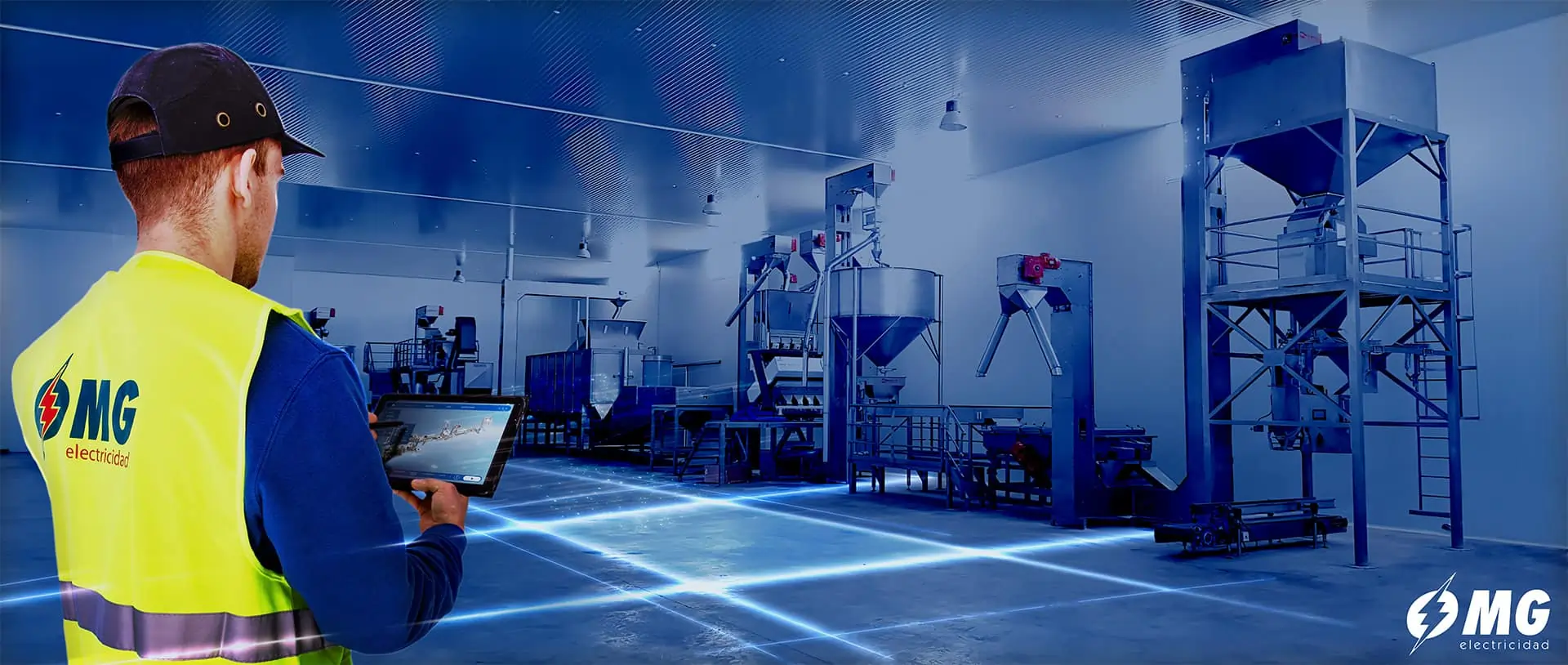
Industrial Automation – Control Interface

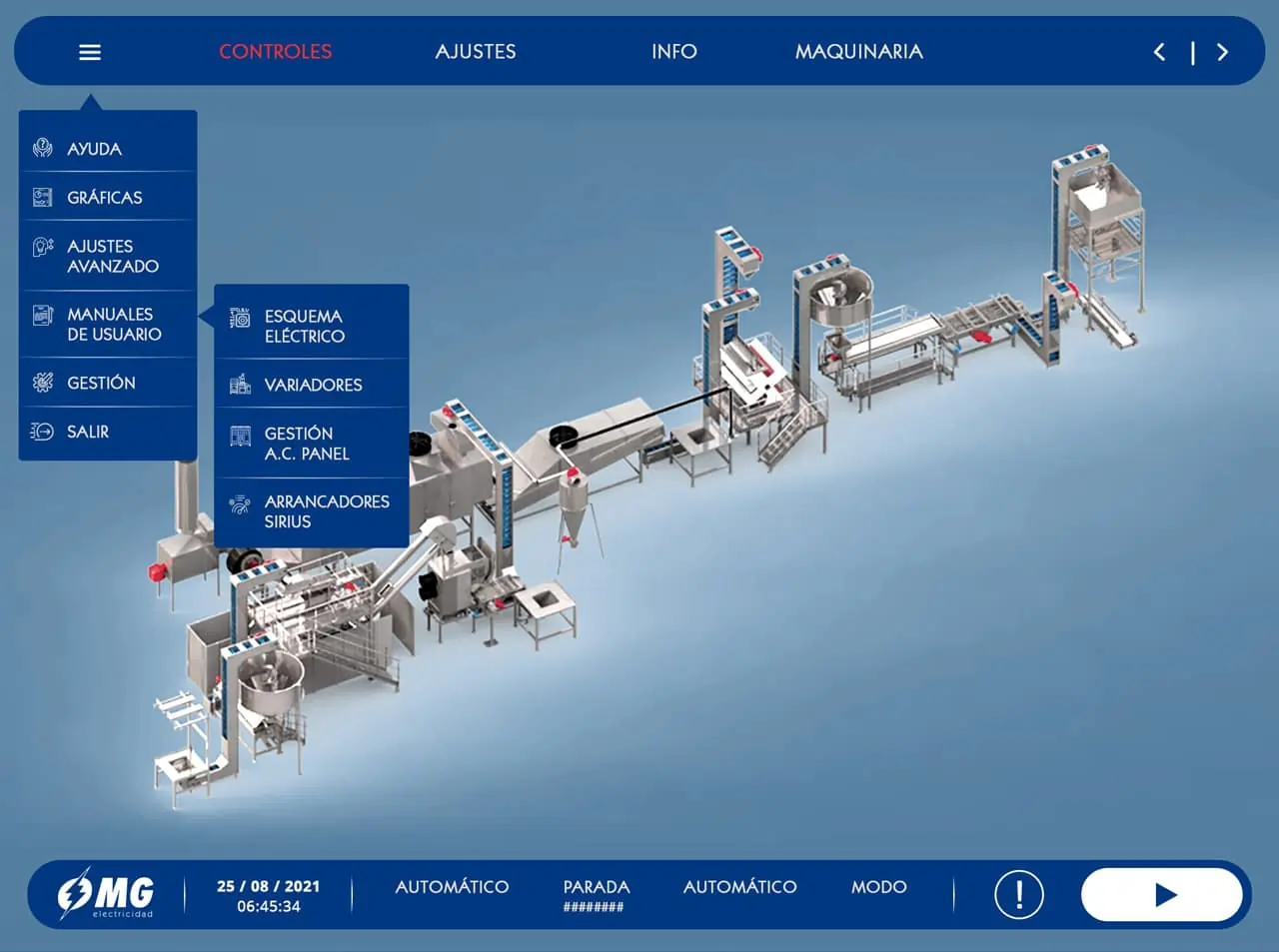

Industrial Automation – Control Interface
Advantages of Process Automation in Your Facility
What Is an Industrial Automation Company For?
1. Higher Productivity
Firstly, industrial automation systems make it possible to automate your factory and its industrial processes, enabling consistent mass production. This improves performance and reduces assembly times.
2. High quality
In addition, automation enables consistently high product quality and uniformity. By relying on continuous process control and monitoring, human error is eliminated from industrial production. Performance remains stable even after extended periods of continuous operation.
3. Robustness
Machines and computer systems operate at a continuous and stable speed. Automated manufacturing processes offer greater reliability, durability, and robustness when managed through an industrial automation system.
4. Adaptability
Implementing a completely new task in a traditional production line often requires hours or even days of individual training. In contrast, with an automated system, reprogramming a robot becomes a fast and straightforward procedure, providing greater flexibility to the manufacturing process.
5. Accuracy and Precision
Data collection increases accuracy and reduces the costs associated with manual processes. This enables faster and better-informed decision-making for those in charge of operations.
6. Safety and reliability
In general, the use of mechanized robots provides a safer environment for workers on production lines and for the production process itself. At the same time, robotic systems increase production consistency and eliminate potential human errors.
7. Reducing industrial production costs
Although the initial investment in industrial automation systems can be high, this innovation significantly reduces data analysis costs and overall production expenses over time.
8. Improving working conditions
Industrial automation systems take over tedious and monotonous tasks that are repetitive for people. This frees technicians from traditional assembly-line work and makes the workday less alienating and repetitive. As a result, they can focus on other, higher-value tasks within the company that contribute greater added value to the final product.


Types of industrial automation systems
Companies that choose to enter the market with industrial automation processes usually rely on different types of systems, depending on the level of adoption, as well as the range, volume, and type of production.
Fixed automation
A fixed automation process in which the robot is configured to perform a specific, repetitive task designed for high-volume production. It follows rigid steps and unchanging processes, yet delivers high speed, precision, and safety.
The main advantage of fixed automation is its high production rate and low operating cost.
Flexible automation
Flexible automation is designed for equipment that must adapt to different product configurations. The processes are controlled by a computer system flexibly configured to adjust its operation to various products.
This type of automation involves a higher cost than fixed automation and a lower production rate. It is intended for facilities that manufacture a limited range of similar products, typically produced in batches.
Flexible automation provides the ability to reconfigure machines for a new product in a relatively short time. Since there is no downtime for reprogramming or physical changes to the machinery, products do not necessarily need to be manufactured in separate batches. It is recommended for medium-scale, continuous production environments.
Programmable automation
Programmable automation is a type of automation in which processes are controlled by a program composed of coded instructions, allowing the system to interpret and execute operations.
It is considered a flexible system, as new programs can be implemented to manufacture new products. However, each reconfiguration requires software updates and, in many cases, hardware modifications. In addition, adaptation is more complex and requires precise timing.
Programmable automation is recommended for industries with low production volumes, where processes are carried out in batch production.
Do you think you could improve your factory’s electrical installation? If you need an industrial automation company, contact us and we will advise you on how to achieve maximum efficiency and profitability.